Contents
Subscribe to our newsletter
Subscribe to the elia newsletter for exclusive product updates and industry best practices. You can unsubscribe at any time.
Thank you! You're subscribed.
Oops! Something went wrong while submitting the form.

.png)

At some point, almost every CEO, HR leader, or office manager hits the same wall. Headcount is changing, the lease is coming up, costs are rising, and someone asks the deceptively simple question, how much office space do we actually need?
In 2026, that question is harder than ever. Hybrid work models are now standard, not experimental. Employees expect flexibility, personal space, and a healthy office environment. Finance teams want less office space and lower fixed costs. Leaders want room for future growth without paying for empty square feet today. Understanding your available space is crucial for balancing office size with budget constraints and making strategic decisions about lease terms, amenities, and space utilization.
And on top of that, office layout choices, technology infrastructure, and company culture all play a role in determining the right office space. Finding the right office space that meets your needs while staying within budget is always a challenge.
This guide is designed to cut through the confusion. We will walk through office space requirements using clear guidelines, realistic examples, and practical formulas. You will learn how much square footage to plan for, how office space needs vary by industry and role, and how modern tools help you move from guesswork to data-backed decisions.
By the end, you should be able to confidently estimate the amount of office space you need today, understand how much space to reserve for future growth, and see how to optimize space utilization as your business evolves.
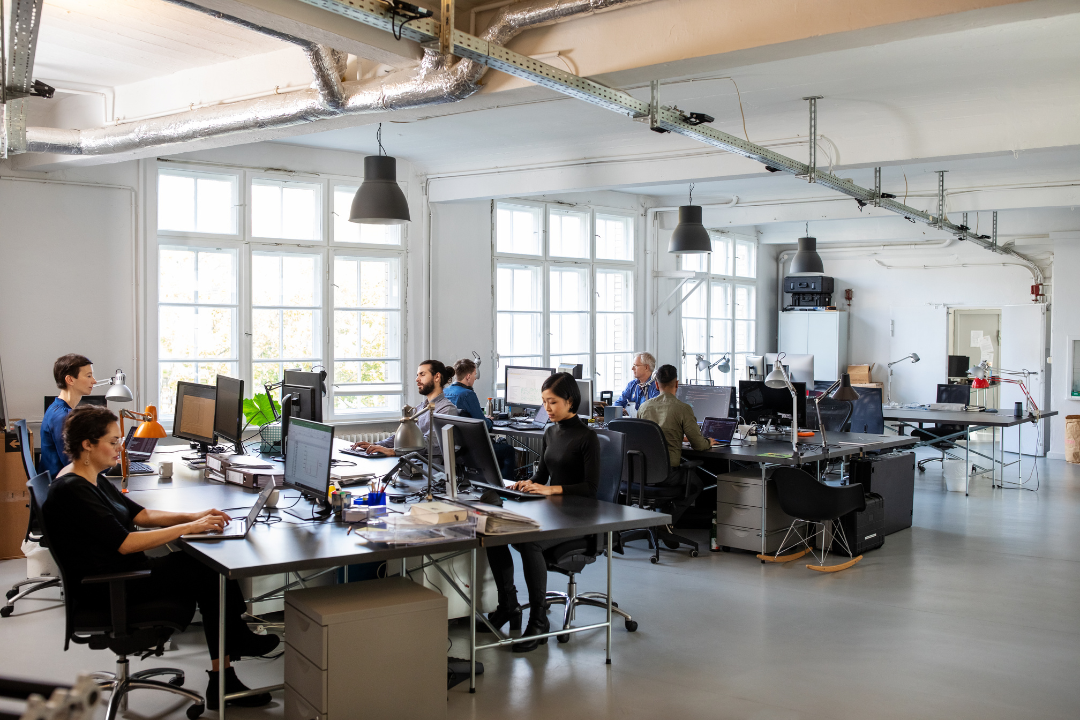
A simple way to think about office space requirements is by density. Density describes how much square footage is allocated per person, including their desk and a share of communal spaces. In 2026, the typical requirement for modern office space ranges between 100 and 500 square feet per employee, and our office space calculator helps you pin down your own number.
Low density, spacious offices
250 to 500 square feet per person
This model is typical for law firms, executive suites, and architecture firms. These environments rely heavily on private offices, larger conference rooms, and dedicated meeting spaces. Client confidentiality, frequent meetings, and senior executives having dedicated space all push the square footage higher.
Average density offices
150 to 250 square feet per person
This is the most common range across industries. It supports a mix of private offices, cubicles, shared workstations, conference rooms, and break rooms. Many traditional office layouts and modern hybrid offices fall into this category.
High density offices
80 to 150 square feet per person
High density environments prioritize efficiency. Open plan offices, open plan layouts, and shared workspace models are common. This approach is often used by startups, sales floors, and call centers where employees work in shifts or rely on standardized workstations.
These ranges offer general guidelines, but they do not tell the full story. Two companies with the same number of employees can have very different office space needs based on how those employees work.
A more accurate approach than flat square feet per employee is role-based allocation. Different roles require different amounts of physical space, privacy, and access to meeting rooms:
By mapping space per employee to actual job requirements, you avoid overbuilding for some teams while under-serving others.
Office space requirements vary widely by industry because company functions, client interactions, and compliance needs differ.
Professional services typically require higher space per employee, often between 200 and 400 square feet. Private offices are common, as are formal conference rooms and meeting spaces for client-facing work. File rooms, storage rooms, and reception areas also add to the total space.
Technology companies and creative teams tend to favor open plan offices and flexible workspaces. Space per employee often falls between 100 and 150 square feet. Collaboration spaces, communal spaces, and break spaces matter more than private offices. Flexible seating and desk booking are common, especially in hybrid work models.
Financial services firms usually land in the average density range of 150 to 250 square feet per person. They require a mix of private offices and open areas, with added attention to compliance, privacy, and secure technology infrastructure.
Call centers operate at high density, often between 50 and 100 square feet per employee. Dedicated workstations, minimal private offices, and a focus on operational efficiency define these environments. Meeting rooms and break rooms still matter, but space utilization is tightly managed.

Start with how many employees you have and how many employees are working in the office. Not everyone requires office space anymore.
You need to distinguish between full-time office workers, hybrid employees, and fully remote staff. For hybrid teams, weekly attendance patterns matter. Most offices see peak occupancy between Tuesday and Thursday, with lower usage on Mondays and Fridays.
Desk sharing ratios help translate headcount into required desks. Ratios like 1 desk for every 2 employees or 3 desks for every 5 to 7 employees are increasingly common. For a deeper breakdown, see our desk sharing ratio guide.
Office layout decisions have a dramatic impact on square footage.
An open office layout or open plan reduces space per employee and encourages collaboration. Open office layouts are specifically designed to encourage collaboration among employees by fostering teamwork and communication. A traditional office layout with cubicles and private offices increases space requirements. Private office-heavy designs, often used by senior executives or law firms, require the most space.
Activity-based working environments change the equation entirely by designing space around tasks rather than assigned desks. The more flexible your layout, the less total space you typically need.
Office spaces are increasingly becoming collaboration hubs rather than just places for individual work. Common areas now often account for 20 to 30 percent of total usable square feet.
You need to plan for conference rooms and meeting rooms, typically 200 to 300 square feet each, or about 15 to 30 square feet per employee overall. Break rooms, kitchens, reception areas, collaboration spaces, file rooms, storage rooms, hallways, restrooms, and circulation space all add up.
As density increases, the need for communal spaces actually grows. Less personal space requires better shared environments to maintain employee well being and employee satisfaction.
Office space planning should look forward, not just at today. It's wise to add a buffer for future growth when estimating office space needs to avoid moving offices frequently. Most organizations plan a 10 to 20 percent buffer to accommodate future growth.
Consider your hiring timeline and the types of roles you expect to add. A team of engineers may need less space than a team of client-facing consultants. For long-term leases, thinking three to five years ahead is critical.
Balancing accommodation for future growth with current costs often means negotiating flexibility, such as expansion rights or subleasing options.
Hybrid work models fundamentally change office space needs. Office space is especially important in a hybrid context because it facilitates collaboration, especially for tasks involving problem-solving and teamwork.
Fixed schedule hybrid models create predictable occupancy. Flexible hybrid policies introduce more variability. Team-based rotation models spread attendance across the week.
Each model affects desk-to-employee ratios and total space requirements. Hot desking and desk hoteling reduce the amount of office space you need, especially when combined with clear policies and supporting technology.
Most hybrid offices achieve between 50 and 90 percent occupancy depending on policy and culture.
Technology infrastructure is often overlooked in early planning.
Server rooms and IT closets usually require at least 100 to 150 square feet. Network equipment rooms need 80 to 100 square feet. Charging stations, power hubs, and printer areas all consume additional space.
Proper cooling, ventilation, and access control are part of your physical space requirements, not optional extras.
Start with total employees, then subtract fully remote workers. Apply a desk sharing ratio based on your hybrid policy.
For example, if you have 200 employees, 40 are fully remote, and you use a 1:2 desk sharing ratio, you need 80 desks.
The formula is simple:
(Total employees minus remote employees) multiplied by desk sharing ratio equals required desks.
Next, choose an appropriate square footage per person based on your density preference.
If you plan for 120 square feet per desk and need 80 desks, your total workspace area is 9,600 square feet.
Required desks multiplied by square feet per person equals total workspace area.
Now add space for conference rooms, meeting spaces, break rooms, reception, storage, and equipment rooms.
A common rule is to add 20 to 30 percent of workspace area to cover these shared spaces. In this example, that would be an additional 1,920 to 2,880 square feet.
Landlords quote rentable square feet, not usable square feet. The difference accounts for hallways, walls, bathrooms, and building infrastructure.
Loss factors typically range from 15 to 25 percent. Multiply your usable total by 1.15 to 1.25 to estimate rentable space.
This is the number that matters for leases.
Finally, add a 10 to 20 percent buffer for future growth.
Multiply your total by 1.10 to 1.20 to arrive at your final office space requirement.
For a more detailed framework, see our office space planning guidelines.

Once you have calculated your office space needs, the real opportunity lies in optimization. Hybrid work has made static planning obsolete. Office layout planning may require more space for storage, furniture, and flexible arrangements to accommodate evolving team needs and optimize overall office capacity for hybrid work models.
For a deeper dive, explore our office space optimization guide.
Research and real-world data show that 1:1 desk assignments are no longer efficient. Ratios between 3:10 and 7:10 are far more realistic for hybrid teams.
Occupancy data consistently shows that Tuesday, Wednesday, and Thursday reach close to 90 percent usage, while Monday and Friday often hover around 50 percent.
The most effective way to determine your ratio is by tracking actual attendance and desk usage. Desk booking software makes this visible and actionable.
Activity-based working shifts the focus from space per employee to space per activity.
Instead of assigning desks, you design zones for focused work, collaboration, social interaction, and learning. Employees choose the right space for their task.
This approach often reduces overall space needs by 20 to 30 percent while improving employee satisfaction and encouraging collaboration.
Static calculations assume ideal behavior. Real offices are messier.
Occupancy sensors and workplace analytics tools track actual usage of desks, meeting rooms, and communal spaces. This data reveals underutilized areas and overcrowded zones.
Companies using real-time analytics often discover they can reduce their footprint or reallocate space without harming productivity. Others use the data to justify expansion with confidence.
Desk occupancy sensors, room occupancy sensors, and occupancy management software turn office planning into an ongoing process, not a one-time guess.
Uncertainty is now the norm. Flexible lease strategies help manage risk.
Coworking spaces can handle overflow or support new markets. Subleasing excess space reduces costs during slow periods. Expansion clauses and contraction rights add optionality.
Short-term leases offer flexibility, while long-term leases may provide cost savings. The right balance depends on your business growth trajectory and tolerance for risk.
Traditional office space planning relies on estimates, averages, and assumptions. Those methods are not wrong, but they are incomplete.
The calculations and office space guidelines in this guide give you a solid starting point. They help you estimate how much office space you need, how much square footage to budget for, and how to plan for future growth.
The most successful workplace strategies go further. They combine planning with continuous measurement. Tracking desk utilization, meeting room usage, and occupancy trends shows you where space is wasted and where additional space is truly needed.
This is where elia comes in. elia provides real-time occupancy data, desk booking analytics, and space utilization insights that transform office planning from static to dynamic. Instead of guessing, you make decisions based on how your office is actually used.
If you are planning a new space, renegotiating a lease, or trying to get more value from your current office, book a demo with elia. You will see exactly how your space performs and where you can optimize.
The payoff is confidence. Confidence that you have the right office space, at the right size, supporting your people, your culture, and your business operations as they grow.
Answers to Your Common Queries
.png)

