Officely vs Robin (2026): Two Different Buyers, Plus a Third Option Worth Knowing
Tamara Zhostka
Content Marketing Specialist
–
Last updated on Aug 20, 2026
Officely costs $3.50 per user per month, lives inside Slack and Teams, and is built by a tiny team of around 5 people. Robin Powered, on the other hand, has an average annual contract of $10K+, and you need to make a sales call to get a quote. According to their own pricing page, they're designed for companies with 500+ employees. That gap tells most of the story.
If you're reading this, you're probably in one of two situations. You're on Slack or Teams and wondering whether Officely is enough. Or you're a larger team asking whether Robin's contract is justified.
This Officely vs Robin comparison is for that decision 🙂
TL;DR: A quick look at Officely vs Robin vs other workplace management software
Officely: great for small teams under 300 who just want to book a desk without all the fuss. It runs in Slack & Teams, costs $3.50/user/month, and has some basic guest tracking... but that's it.
Robin: this is a full-on enterprise platform with a $10K+ average contract and visitor management included. It's a good fit for teams making real estate decisions and managing external visitors at scale.
elia: one vendor for all of your needs. Desk booking, rooms, visitor management, and sensors. Worth knowing if neither of the above fits. Starts free.
What is Officely?
Officely started as HotelFlex, a hotel booking platform that went through Y Combinator in 2017. Then COVID hit, and overnight, the hotel market vanished, so its founders Max Shepherd-Cross and Rich Turnbull pivoted to booking office desks instead. The idea was pretty simple: exact same coordination problem, just different type of room.
It’s used by over 15,000 employees at 500+ companies, with about 50,000 people registered to use the service each month. G2 gives it a 4.6/5, and the reviews all say the same thing: people actually book, because there's nothing new to open.
Detail
About Officely
Founded
2021, London (originally HotelFlex, YC S17, 2017)
Team
~5 people, London-based
Clients
CloudTalk, Adaptavist, Bolt, Nordcloud, Lunio
Find them
Primarily inbound; don't see them at conferences much
Follow
Kristina Semcenko (GM) on LinkedIn for her takes on hybrid work
Key features
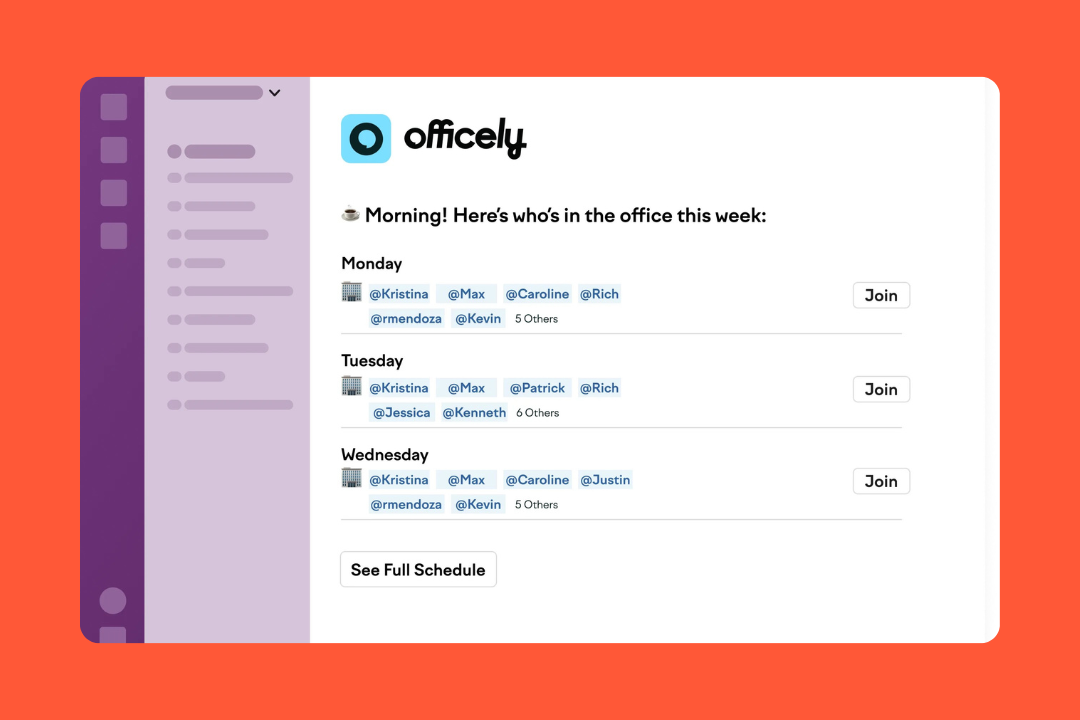
Desk booking is the main event. You open Slack or Teams, see who's coming in, pick a desk or neighbourhood, and confirm in 2 clicks. If someone doesn't show up, the desk auto-releases, which keeps the occupancy data accurate. Recurring bookings (they call them routines) mean you can set your weekly schedule once and not have to worry about it.
Room booking is a separate product, Meeting Rooms by Officely, priced per room per month. Rooms get tags for capacity and amenities (projector, whiteboard, speakerphone), so you can filter by what you need from Slack or Teams. Live availability, no double bookings.
Parking is separate too, called Parkly, with one-click booking and auto-release on no-shows.
The analytics dashboard keeps track of bookings, check-ins, no-shows, and policy compliance. Instead of someone chasing people or pulling manual reports, the system surfaces who's hitting their minimum office days and who isn't.
HRIS is one of the stronger parts of the product, and I think it gets overlooked. They connect to 30+ HR systems: BambooHR, HiBob, Personio, Rippling, Workday, SAP SuccessFactors, Deel, Oracle HCM, and a long list of European tools like PayFit, Lucca, Factorial, and Kenjo that many competitors skip.
Office extras let you book team lunches, after-work drinks or flag that your dog is coming in. Small feature, but a nice touch.
Pricing
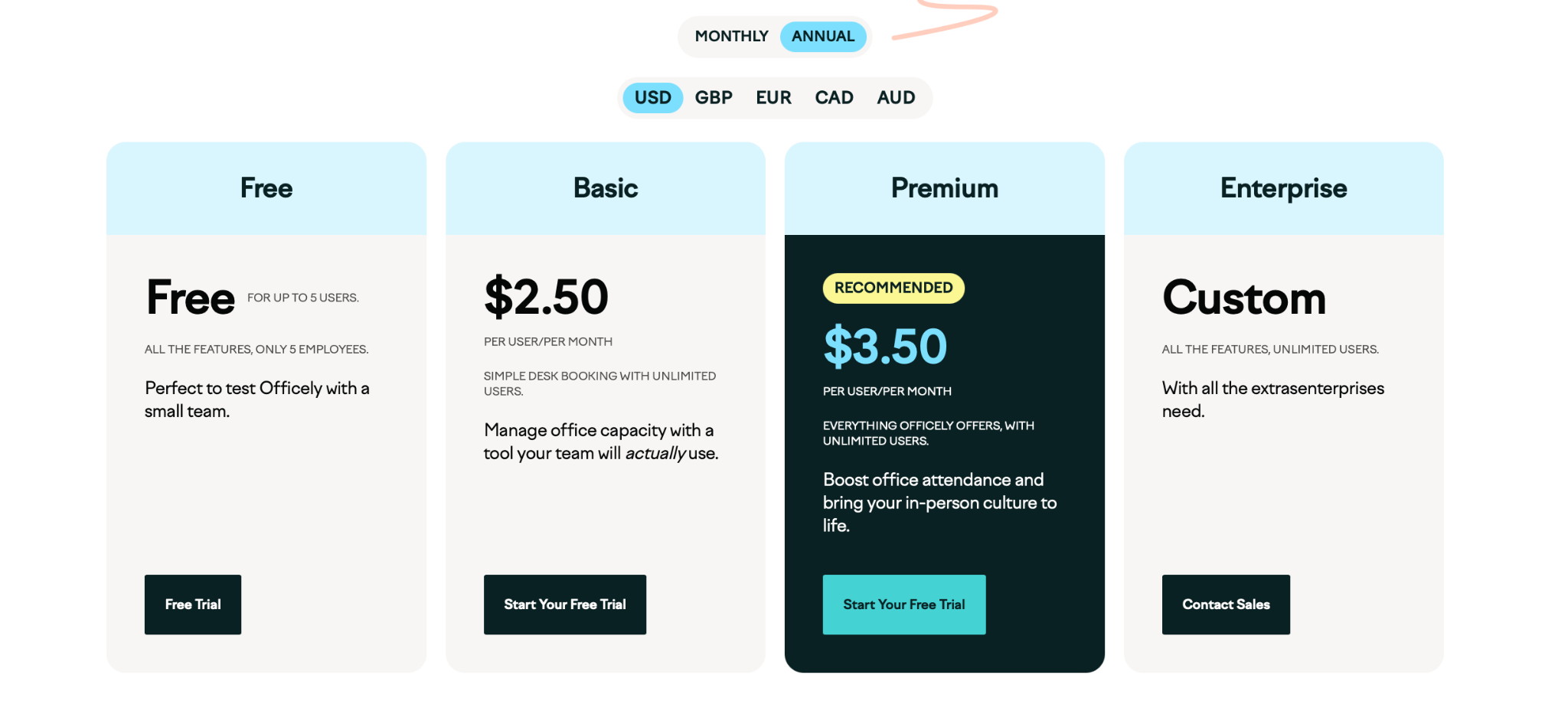
Desk booking is per user. Meeting Rooms and Parkly are separate, charged per space.
Plan
Monthly price
Users
Free
Free
Up to 5
Basic
$2.50/user
Unlimited
Premium
$3.50/user
Unlimited
Enterprise
Custom
Unlimited
Meeting Rooms: $12/space/month. Parkly: $15/space/month. Free trial on paid plans, no credit card required.
Basic covers desk reservations, capacity management, and office analytics. Their Premium tier adds in the HRIS integration, smart coordination features, and compliance tracking. SSO is on the Enterprise plan.
If you're running all three products, the per-user number doesn't tell the whole story. A 100-person team on Premium with 10 meeting rooms and 15 parking spots is $350 + $120 + $225 = $695/month. Still competitive, but calculate before you compare.
Source: Officely
Where they shine
Adoption is the reason Officely stands out. Adaptavist put it plainly: "Keeping everything in Slack means people actually use Officely. Unlike other tools we've tried." CloudTalk makes a similar point from a different angle: the thing that people value most is the fact that it shows them what they're missing when their colleagues are in the office.
Setup is fast. Several reviewers rolled it out company-wide without running a training session. The 10-minute claim holds.
The HRIS integration list is pretty impressive. 30+ systems, including European tools. If you're on Personio, PayFit, Lucca, or something outside the usual shortlist, check their integrations page before you make the comparison.
Pricing is transparent. $3.50/user/month for Premium. No demo required to find that out.
Support is good. Named contacts, fast turnaround, and willingness to solve odd setup requests.
What to consider
Slack or Teams only. There's no standalone app, so if your company isn't on either platform, this isn't the right fit.
Visitor management is limited. Officely has an "Invite Guests" feature on Slack that’s not available on Teams at all. There's no kiosk, NDA collection, badge printing, or host notification workflow. If you are bringing in external visitors on a regular basis, you may find the gap between Officely and Robin's offerings a bit too wide to overlook.
No hardware. Occupancy data comes from bookings and check-ins, not sensors. You see what people said they'd do, rather than what actually happened. Passive occupancy tracking isn't available.
Analytics only goes so far. Good for compliance and showing who's meeting their office minimums, not much else. Space forecasting and lease decision modeling aren't there. If your facilities team needs to justify real estate decisions with data, Officely's dashboard probably won't cut it.
The per-user price isn't the full number. Rooms and parking carry separate per-space charges. Run the actual total before comparing to tools that bundle everything into one fee.
What is Robin?
The founders of Robin built a conference room table that knew when a meeting was happening. That was at their digital agency in Boston, before Robin existed. The prototype convinced them there was a product in it, and they launched Robin in 2014. Twelve years later it's a named Leader in the 2026 Gartner Magic Quadrant for Workplace Experience Applications.
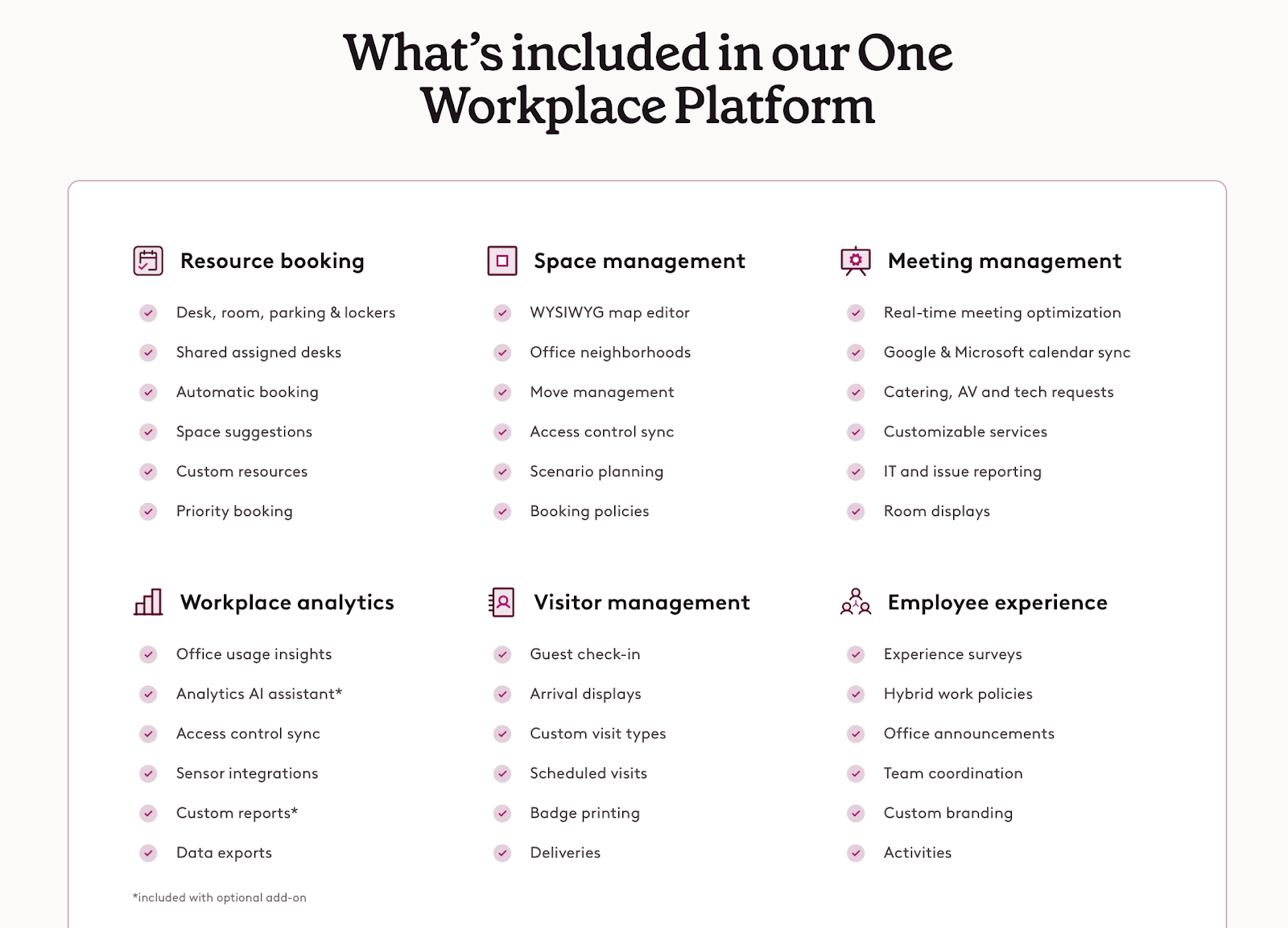
The product has grown well past conference rooms: desk booking, visitor management, space analytics, and access control integrations. G2: 4.4/5. They say they're built for 500+ employees, and they mean it.
Space Forward (weekly newsletter on workplace trends); CEO Micah Remley and Brian Muse are both active on LinkedIn
What Robin does that Officely doesn't
Visitor management. Where Officely lets you note a guest, Robin has a full system: kiosk check-in, NDA signing, badge printing, host notifications, delivery management, and custom registration forms. If you're bringing in a lot of clients or contractors, this is probably the difference that tips the scales in Robin's favour.
Analytics depth. Robin tracks attendance and workplace collaboration like a pro. It has numerous KPIs, a scorecard for in-person meetings, badge data, and even sensor integration. For a facilities team trying to make the case for a new lease, Robin has got your back.
Meeting services. When you book a meeting, you can attach catering requests and IT tickets. They'll even follow you if the meeting gets moved. Officely doesn't have this operational layer.
AI desk booking. Robin learns your habits and books a desk for you when you show up. Officely's booking process is all manual. Some teams might not notice the difference, but for others, it's a big deal.
Web and mobile apps: Just to be clear, Robin also has native Slack and Teams integrations. From Slack, employees can book desks and confirm or cancel reservations without leaving the app. The Teams and Outlook integration goes further with desk booking, room suggestions, catering requests, and visitor management all from inside Microsoft 365. The difference from Officely is that Robin has a full standalone web app and mobile app. Officely has neither.
Pricing
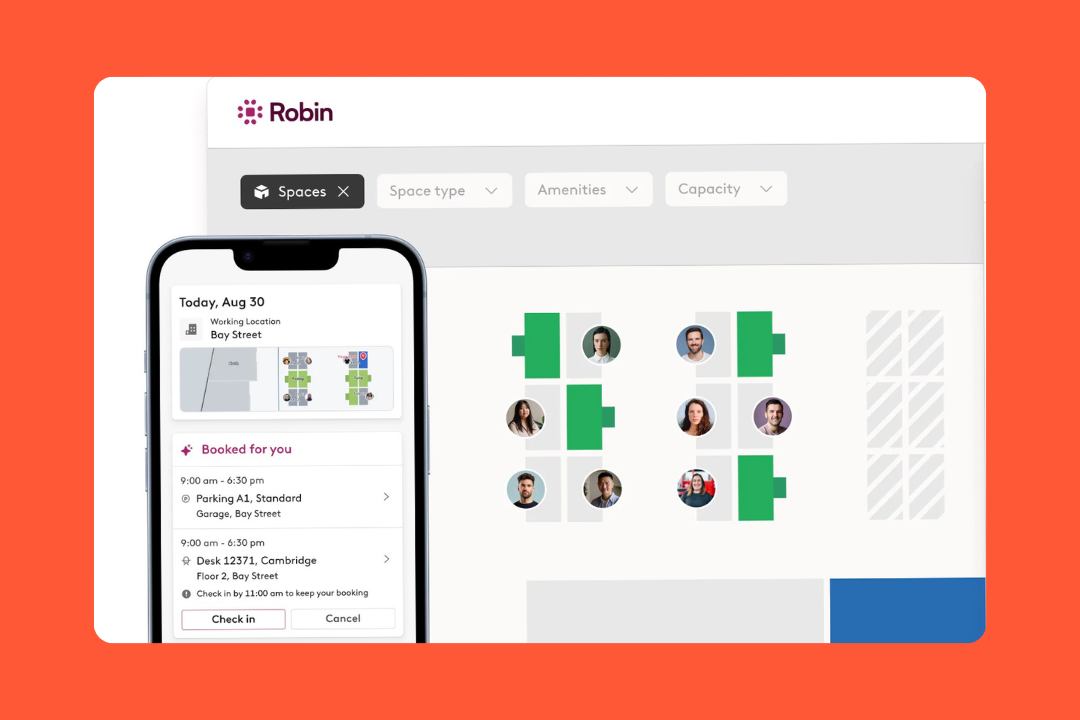
They don't put their prices on their website. You have to book a demo to get a quote. Based on Vendr data from 55 Robin purchases, the average annual contract is $10,458 and buyers save 21% on average.
Source: Robin
Where they shine
The analytics lead to real decisions. TraceLink cut 10,000 square feet using Robin's utilization data. athenahealth shifted from gut feel to actual numbers on space planning.
Visitor management and meeting services come standard. You don't have to pay extra for the things a 500-person office needs every day.
Once deployed, IT support requests about it disappear. You can roll Robin out with just an email to everyone in your company. Unusual for a platform this size.
Access control matters. Integrations with Brivo, Gallagher, Genetec, Verkada, Genea, and Avigilon (formerly Openpath) mean workplace data talks to your badge system. At the price points Robin operates at, buyers in regulated industries or larger enterprises expect this.
Certified and compliant. SOC 2 Type II, SAML 2.0, and SCIM provisioning are all ticked off.
What to consider
The cost leap is a big one. A 100-person team going from Officely Premium to Robin is roughly 1.5-2x the annual cost. If Officely solves your problems, that's hard to justify.
Major floor plan changes go through Robin's team. Small tweaks can be self-served, but full redesigns still mean coordinating with your vendor.
The AI analytics story is a work in progress. The AI desk booking works. The Analytics AI Assistant currently can't answer real-time questions or build charts. Robin's own docs say so.
500 employee minimum. It's right on their pricing page. So, if you're under that number, they might steer you elsewhere. That said, Vendr's median contract implies Robin sells to smaller teams in practice.
The mobile app gets mixed reviews. Users mention time format inconsistencies, dashboard date issues, and Outlook complications in multi-tenant setups.
Officely with 10 rooms + 15 parking spots: $695/month, $8,340/year
Robin: Vendr puts realistic annual contracts at $10,000-$20,000 after negotiation
At 100 people, Officely is almost always cheaper. Visitor management and deeper analytics are what Robin's cost buys you. If you don't need those, the math doesn't work in Robin's favor.
Scenario 2: Hybrid teams of 200 and beyond
This is where the math gets harder to pin down. Officely's published pricing is for unlimited users on paper, but in practice, larger teams might get quoted Enterprise, which is custom. There's no public number for that.
Robin's pricing is also custom at this scale (on any scale, really). You're comparing two unknowns, which means the only honest answer is: get quotes from both and negotiate from there.
Officely vs Robin: feature comparison
Feature
Officely
Robin
Where it runs
Inside Slack and Microsoft Teams, no standalone app
Standalone web app + mobile app; also works natively inside Slack and Teams/Outlook
Desk booking
Manual, 2 clicks, routines, neighborhoods, floor plan view
30+ (BambooHR, HiBob, Personio, Rippling, Workday, SAP SuccessFactors, Deel, and European tools)
Rippling, BambooHR, Workday and others
Access control
None
Brivo, Gallagher, Genetec, Verkada, Avigilon
AI features
None
AI desk booking, AI room suggestions, AI analytics assistant (add-on)
Parking
Separate product, $15/space/month
Early access, confirm before committing
Pricing model
Per active user
Not published, requires sales call
Minimum team size
None stated
500+ (stated); smaller in practice
G2 rating
4.6/5
4.4/5
Setup time
~10 minutes
Longer; implementation support common for larger rollouts
Info as of May 2026. Features and pricing can change; confirm with each vendor before deciding.
Officely vs Robin: best for
Choose Officely if your team runs on Slack or Microsoft Teams and you want a tool people adopt without any friction. For small businesses under 300 employees where attendance visibility and compliance tracking are the main goals, Officely does the job at a price that's hard to argue with.
Choose Robin if external visitors come through regularly, your facilities team is making real estate decisions that need utilization data, or you need access control to connect to your workplace platform. For teams of 300+ that want desk booking, rooms, visitor management, and meeting services from a single vendor, Robin consolidates all of it.
The gap the other two don't fill
Both of those put you into one of two camps. But there's a third buyer category this comparison is overlooking.
You need more than Officely: visitor management for external guests, occupancy sensors that show what's happening in the space, and utilization data beyond who booked a desk. But Robin doesn't fit either: the big price tag, the 500+ employee approach, and the sales process that has you guessing before you see a number.
That buyer is a real category. Mid-market, typically up to 300 people, running a hybrid office that needs the full package (not just desk booking). If that's you, elia is the one to look at.
What is elia?
elia is a workplace management platform from Quebec City. Its desk sensors, room sensors, kiosks, room displays, and smart locks all come from the same vendor as the software. No third-party hardware to source or integrate separately. This sets it apart from Officely (no hardware at all) and Robin (integrates with third-party vendors).
It's used by over 100,000 people across 200+ organizations, mainly in Canada and the US. Fewer organizations than Officely's 500+, but more total users. The average elia customer runs a larger office. Capterra gives it 4.7/5 across 57 reviews.
Detail
About elia
Founded
Quebec City, 2018, originally as GPHY
Team
30+ employees
Clients
Québecor, Cascades, Agropur, Fasken, Canadian Cancer Society, Air Transat
Booking a desk works straight off the interactive floor plan. You can see where your colleagues are before you confirm, book a desk for someone else before they show up, or invite a teammate with a click. Neighborhoods, recurring bookings, and third-party bookings are all in.
Room booking syncs both ways with Microsoft Outlook and Google Calendar. Room displays connect natively to the platform, and you can share rooms between organizations in the same building. All the displays are compatible with Microsoft Teams Rooms, too.
Visitor management is built right in. Self-service kiosk check-in works on tablets, or visitors can use QR code touchless check-in on their own device. NDAs, document collection, host notifications via email, Slack, or Teams, delivery management, and audit-ready visitor logs are all there.
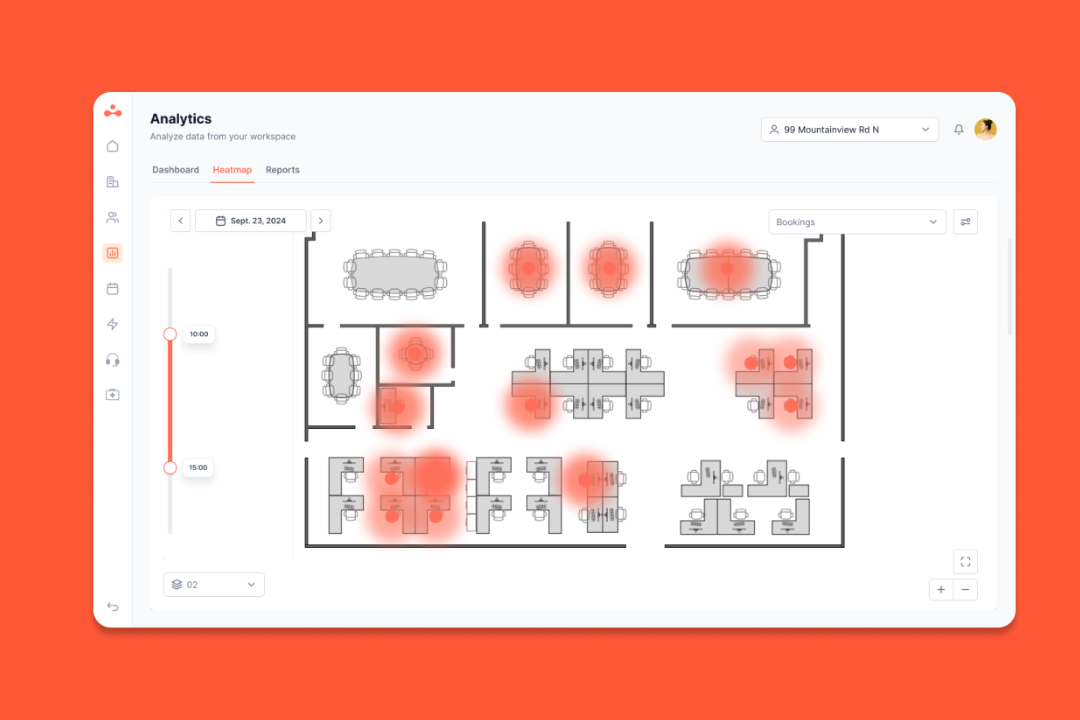
Occupancy management uses battery-powered desk sensors and room passage sensors. No wiring or IT setup needed. Heatmaps and dashboards show real occupancy against bookings, so you can see the gap between what people said they'd do and what happened.
Request management covers catering, IT, and maintenance requests submitted from the floor plan, linked to room bookings. If the meeting gets cancelled, the requests go with it.
The health and safety module has no equivalent in Officely or Robin. First responder availability on the floor plan in real time, digital incident logging, certification renewal alerts, and compliance records.
Pricing
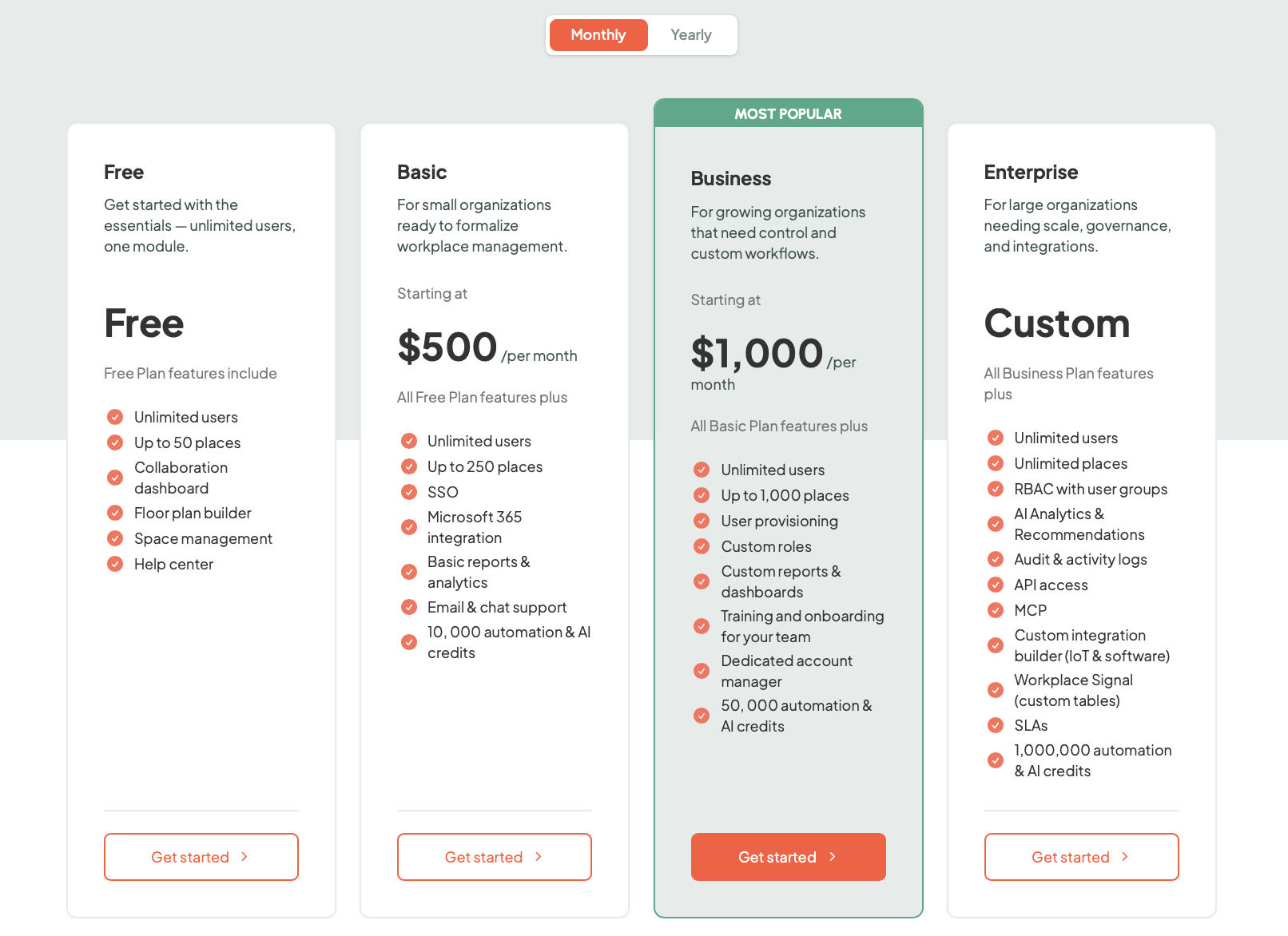
elia's pricing is tiered by the number of places (desks, rooms, lockers, and parking spots) with unlimited users on every plan and a free tier to start. Hardware is optional on top of any plan.
Plan
Monthly price
Users
Places
Free
$0
Unlimited
Up to 50
Basic
From $500
Unlimited
Up to 250
Business
From $1,000
Unlimited
Up to 1,000
Enterprise
Custom
Unlimited
Unlimited
Places cover desks, rooms, lockers, and parking spots combined. The free plan's 50 places suit a single team or small office, Basic's 250 a growing one, and Business (the most popular tier) covers up to 1,000. What sets the tier is how many places you book, not your headcount: users are unlimited on every plan. Companies that need more than 1,000 places move to Enterprise, so ask about that early.
Source: elia
Where they shine
Sensors and software from one vendor. Officely has no hardware, and Robin integrates with third-party vendors. elia owns its hardware stack: desk sensors, room sensors, and visitor kiosks all connect natively to the platform. No separate vendor to manage, no middleware layer.
Published pricing, free to start. There's a free plan, and the Basic and Business tiers are listed on the website, no sales call to get a number. That transparency, plus a free entry point, is the real advantage over Robin's quote-only model.
The health and safety module is unique. elia has first responder tracking on the floor plan, incident logging, and certification renewals. Neither Officely nor Robin has an equivalent.
Floor plan admin is self-serve from day one. Robin's larger changes still go through their team. With elia, admins own it end-to-end from the moment they log in.
Teams go live without IT support. Capterra gave elia Best Ease of Use 2026 in Space Management, Desk Booking, Meeting Room Booking, and Visitor Management. Customers say the same thing: no training session, same-day rollout.
What to keep in mind
The review base is small, and they’re not on G2 yet. elia is expanding outside Canada, so this is changing, but just be aware if the review volume is a factor in your decision.
Hardware adds cost. Sensors, displays, and kiosks are priced separately from the software subscription. If you want the full occupancy picture, budget for the hardware layer on top.
No access control. Robin connects to Brivo, Gallagher, Genetec, Verkada, Genea, and Avigilon. elia doesn't.
Mostly North American customer base. Most of elia's organizations are in Canada and the US. If you're in Europe, support hours and the customer community skew North American.
The places cap is worth checking. Each paid tier caps the number of places (desks, rooms, lockers, parking), so run the numbers on your space before you pick a plan, though the free tier lets you try it at up to 50 places first.
These don't get the full treatment here, but depending on your situation they're worth looking at.
Envoy: one of the better-known names in this category, starting with visitor management and adding desk and room booking on top. G2: 4.4/5. Pricing starts at $109/month but adds up fast. Visitor management alone runs $362+/location/month at scale. Worth looking at if visitor management is your primary need.
Tactic: similar positioning to Officely but with visitor management included. Core plan is $3/workspace/month (desk and room booking, analytics), Pro is $4/workspace/month (adds visitor management, SSO, and Tessa, their AI assistant). Good option if you want Officely-style simplicity without patching visitor management on separately.
Kadence: desk and room booking with a strong team coordination angle, backed by Stanford economist Nick Bloom. Active user billing model. Includes an AI-powered space planning add-on for scenario planning and occupancy modeling that neither Officely nor Robin offers out of the box.
Condeco (now Eptura Engage): enterprise workspace scheduling, recently rebranded as part of Eptura. No public pricing, custom quotes only, aimed at 250+ employee organizations. Deep Microsoft 365 integration across Outlook and Teams. If you're already fully committed to Microsoft infrastructure, it competes directly with Robin.
Which is the right workplace management software?
The choice between Officely and Robin usually comes down to visitor management and analytics. If your office doesn't need either, Officely's price is hard to beat. If it does, Robin's contract reflects that scope.
elia is for the team that wants that same scope (visitors and analytics) with pricing it can see upfront and start free, rather than a quote-only contract. For a small or mid-size office that comes in well under Robin's $10K+ average; at the Business tier plus hardware the totals get closer, so elia's edge is transparency and a free starting point as much as price.
If you're still undecided, the question is: do people outside your company come through your office regularly? If yes, Officely isn't the right answer. From there, your budget and headcount determine whether it's Robin or elia.
Your office, finally in sync
Help teams find the right space, right when they need it.
is a Content Marketing Specialist at elia. With 10+ years in content marketing, she writes about workplace trends and the tools that help teams work smarter. Part strategist, part storyteller, Tamara brings equal amounts of data, creativity, and a little Moon Prism Power to every piece she creates. 🌙✨
Share
Contents
Subscribe to our newsletter
Subscribe to the elia newsletter for exclusive product updates and industry best practices. You can unsubscribe at any time.
Thank you! You're subscribed.
Oops! Something went wrong while submitting the form.
Frequently Asked Questions
Answers to Your Common Queries
Does Officely support hot desking?
What's the total cost of Officely vs Robin?
Do Officely and Robin show real-time room availability?
Which one has a steeper learning curve?
Can these tools track in-office days for hybrid teams?



.png)