Skedda vs Robin (2026): A Side-by-Side Comparison, Plus One Option if Neither Fits
Tamara Zhostka
Content Marketing Specialist
–
Last updated on Aug 20, 2026
Skedda and Robin show up on every hybrid office shortlist. Both nail hot desking and room booking, but that's where the similarities end.
Skedda targets small to midsize orgs: a strong rules engine, per-space pricing, and a setup that'll have you up and running in under 24 hours.
Robin, on the other hand, is an enterprise workplace management platform that says on its own pricing page it's designed for 500+ employees and won’t share pricing until you book a call.
If you're mulling over Skedda vs Robin, you've probably already started the evaluation. The decision really just comes down to the size of your team, your budget, and how deep you need your analytics to be.
TL;DR: Skedda vs Robin vs other tools
Skedda: strong booking rules at the entry price point. Analytics and per-space pricing do hit a ceiling as you grow, though.
Robin: enterprise analytics with developing AI, but only if you have 500+ employees.
Another option to consider: elia is a one-stop shop for your whole workplace stack, no matter the size.
What is Skedda?
Skedda is a space booking and workplace management platform. They started up in Melbourne back in 2013 and have since gone on to become US-headquartered with a global team that's always on.
More than 8,000 organizations (corporate offices, universities, labs, clinics) rely on them, and that's not to mention the 3 million plus users who've booked space through their platform (per their About Us page). They’re rocking a 4.8/5 on G2 across 281 reviews, and have been ranked #1 in Space Management for three years running, along with awards for Best Support and Easiest to Set Up in 2026.
Detail
About Skedda
Founded
2013, Melbourne. Now US-headquartered.
Team
100+ employees. Their sales team is the life of the party, bringing espresso machines to FM conferences and taking customers to Celtics games.
Clients
PVH Corp, Aon, Brown Bag Films, Boston University, Harvard University.
Find them
IFMA World Workplace, NFMT East (facilities management conferences).
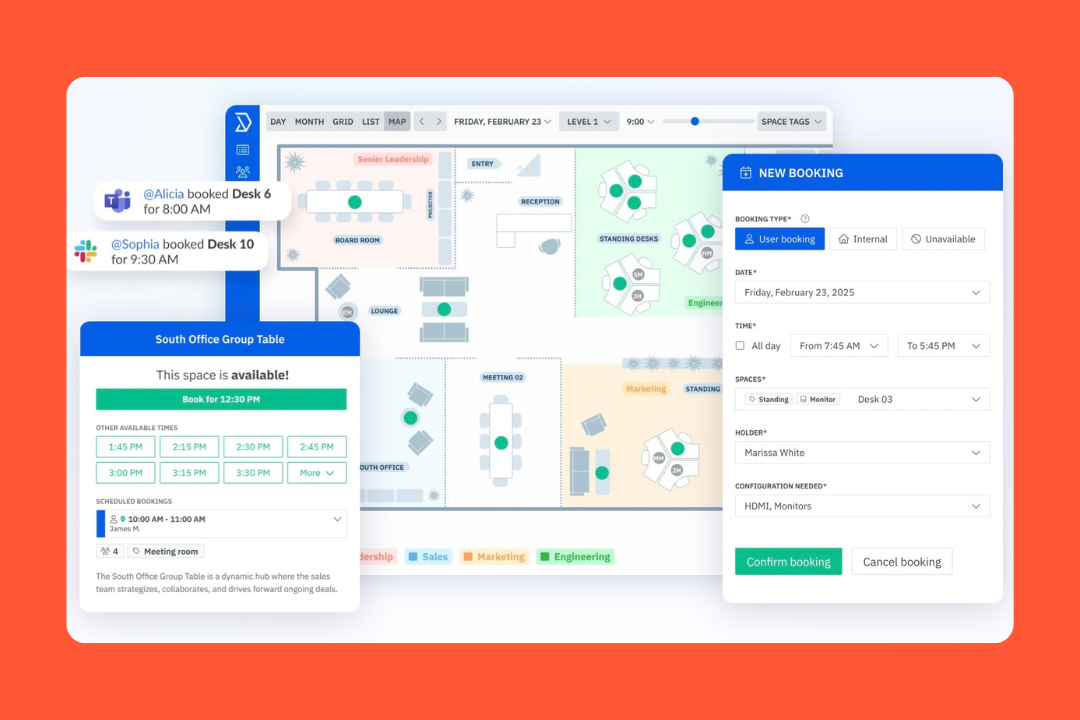
Desk booking is easy to use. You can book a desk for the day (hot desking) or reserve the same spot each week, all through interactive floor plans, a mobile app, or inside Microsoft Teams. The best part is that you can see where your colleagues are sitting before you commit. Desks auto-release if no one checks in via mobile, QR code, or Wi-Fi.
Meeting room booking syncs two-ways with Microsoft 365, Outlook, and Google Calendar. Tablet displays sit outside rooms showing live availability. Oh, and they've launched Zoom integration in February 2026.
The rules engine is the real MVP. You can limit teams to specific zones, cap bookings at 4 hours per person per day, block same-day reservations for certain rooms, add buffer gaps between bookings, or route spaces through an approval process. Once you've set it up, it just does its thing.
Workplace analytics cover all the bases: utilization rates, booking patterns, peak hours, no-show rates, and top users and spaces by booking volume. A newer Wi-Fi-based passive attendance feature also detects who's on-site without sensors or manual check-in.
Visitor management is available as an add-on, not included in the base price.
Integrations are a-plenty: Microsoft 365, Google Workspace, Teams, Slack, Logitech Tap Scheduler, Kisi, Zapier, Okta, Entra ID, JumpCloud, Stripe, Xero.
Pricing
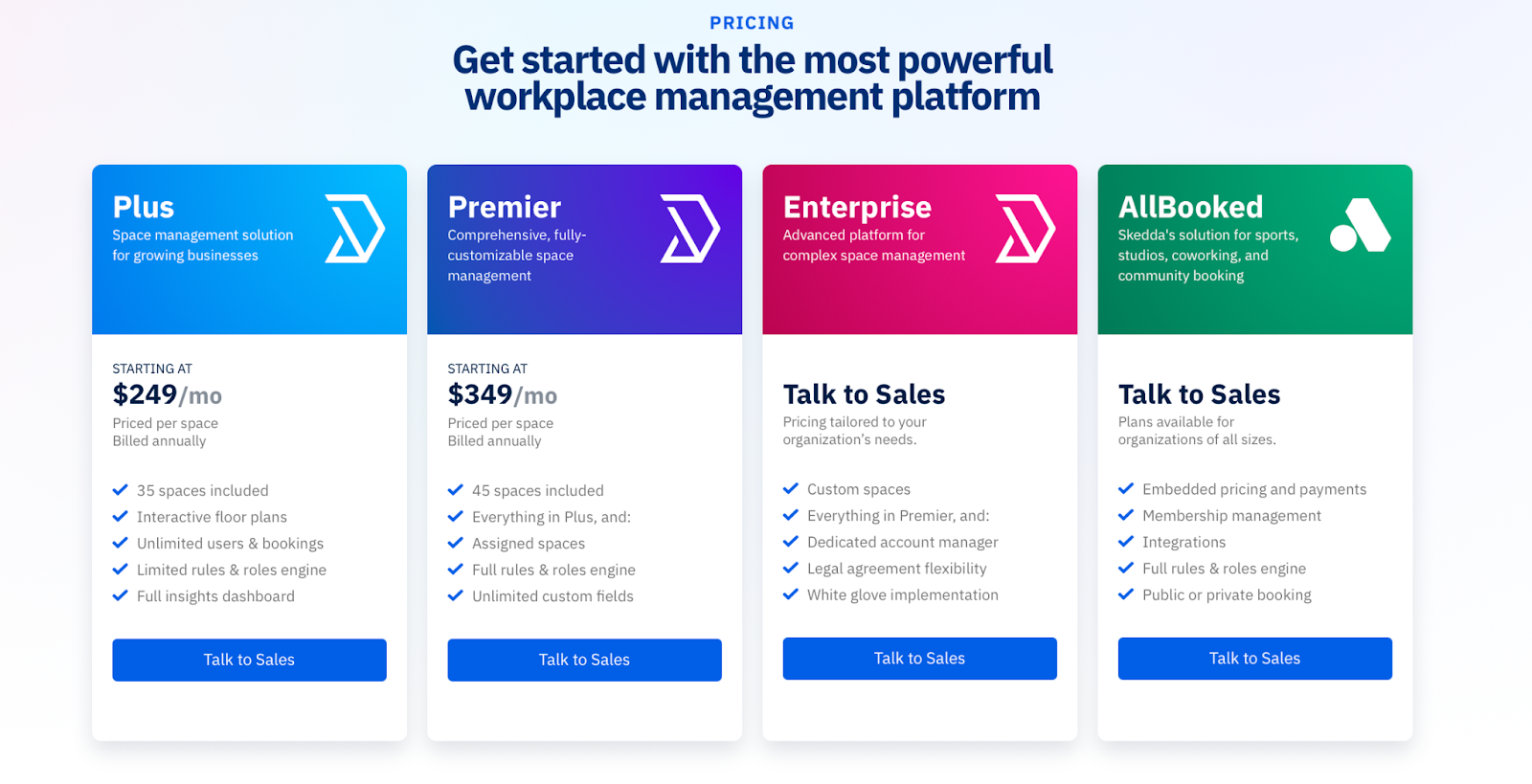
Skedda charges per bookable space, and you get unlimited users on every plan.
Plan
Price/month
Spaces
Plus
$249
35
Premier
$349
45
Enterprise
Custom
Custom
Visitor management comes at $99/month extra. There’s also a 14-day free trial with no credit card required.
Source: Skedda
Where they shine
The rules engine is one of the best at this price point. Organizations with non-standard access requirements (labs, law firms with confidential rooms, universities with mixed faculty and student access, clinics) often cite it as the reason they chose Skedda.
Support team is a standout. They do named contacts, custom tutorial videos made for your specific setup, and fast response times.
Transparent pricing and a 14-day trial with no catch. You can try it out before anyone asks you for payment details.
It works for non-standard spaces. AllBooked (same team) handles sports courts and community spaces too. If you're booking anything other than desks and rooms, it's worth a look.
It’s fast to launch. Several reviewers rolled it out to their entire company without needing a single training session.
What to consider
Per-space pricing bites at scale. Any bookable item (whether it’s desks, rooms, or parking spots) counts towards your plan limit. So a 200-person office with 80 desks, 8 rooms, and 15 parking spots is already at 103 resources: above the Premier tier and into custom pricing territory.
Visitor management is an extra cost. If you need it, you need to factor that in when you're comparing the base price.
Analytics cover day-to-day management well but not real estate planning. Utilization rates and peak hours are there, but space forecasting and AI-assisted modeling are not. For a facilities team trying to justify a lease decision, that matters.
No employee experience layer. Skedda is a booking platform. There are no office satisfaction surveys or team activity tools built in. If driving attendance through engagement is part of your strategy, you'll need a separate tool for that.
Syncing with Slack & Outlook gets mixed reviews. Some users report friction in multi-tenant Microsoft setups. Group booking edits also send out individual notification emails rather than one summary.
What is Robin?
Robin is an enterprise workplace management platform that started in Boston in 2014 when companies were still using paper notes on the door to manage conference rooms. It now serves over 8,000 companies across 80 countries, with over 200 million desks booked. On G2, it holds a 4.4/5 across 211 reviews.
Robin is also honest about who it's not for. Their pricing page says it plainly: if you want something like room display software only, there are better options out there. They want companies with 500+ employees and some serious hybrid complexity.
Detail
About Robin
Founded
2014, Boston (still there).
Team
340+ employees who call themselves Robinauts. Every Thanksgiving, the offices get together to paint Bob Ross landscapes (they call it RossCon).
Space Forward (weekly newsletter on workplace trends); Brian Muse and CEO Micah Remley are both active on LinkedIn.
What’s in it
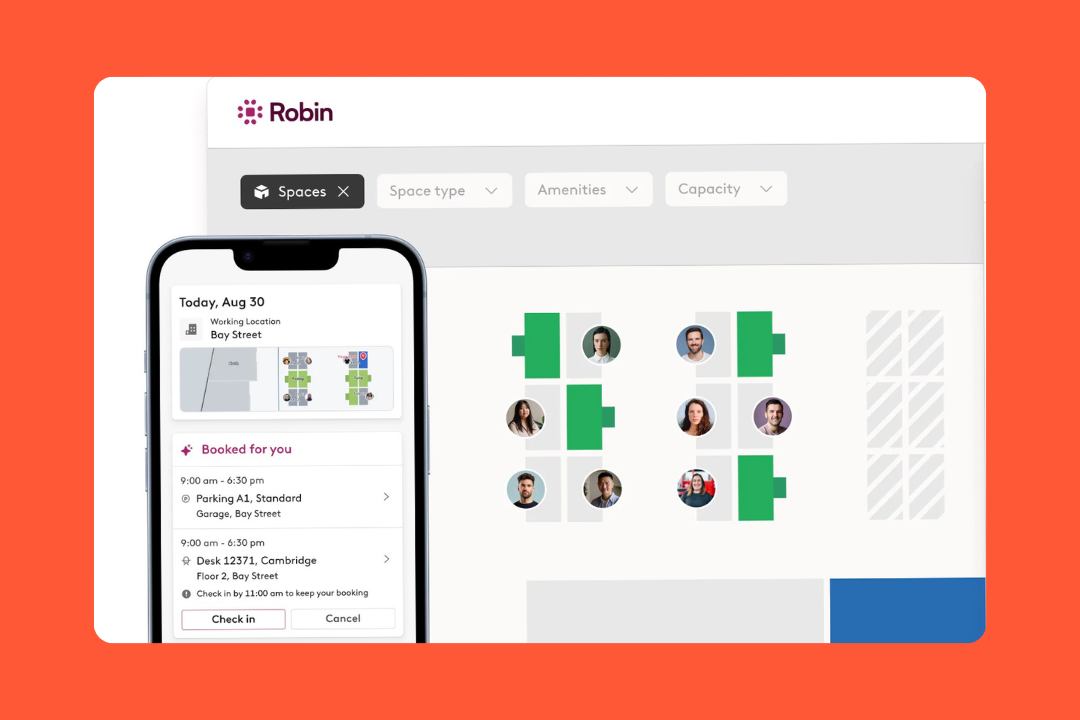
Desk booking uses AI automatic booking. Robin learns from your past patterns and preferences and reserves a desk for you when you’re coming in. Priority booking, multi-day reservations, QR codes, and auto WiFi check-ins are all part of the deal.
Room scheduling is still probably its strongest feature. You get room displays (compatible with Logitech Tap Schedulers) showing availability outside the door. AI suggests the right room for the job based on the number of people involved and the kit they need. Abandoned meeting protection auto-releases rooms when no one turns up.
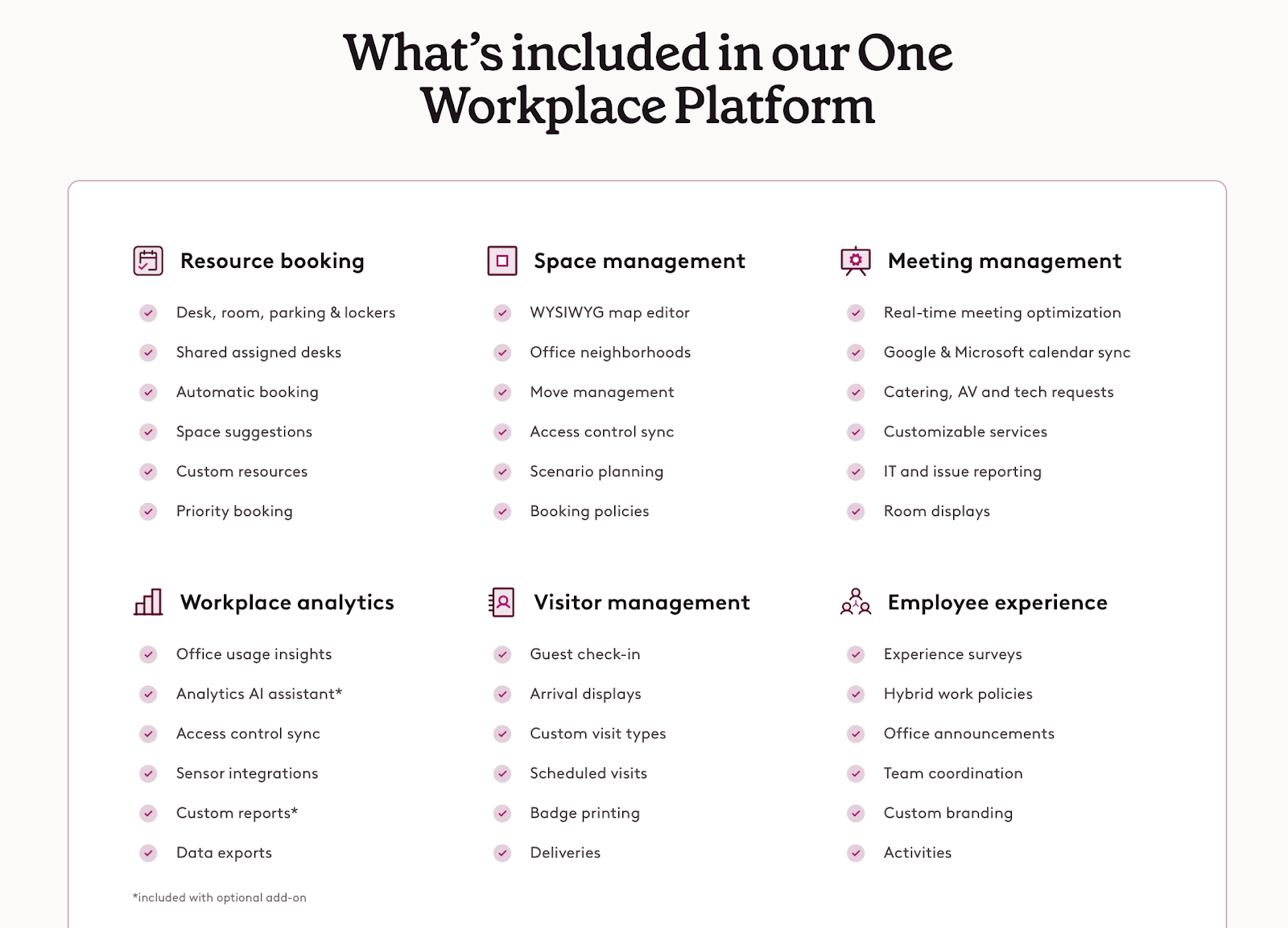
Visitor management is built right in. Pre-registration, NDA collection, host notifications, badge printing, delivery management, and custom registration forms are included without an add-on fee.
Meeting services let you tie catering requests and IT support tickets to bookings. If a room changes, the associated requests update automatically.
Workplace analytics are Robin's strong suit. The Workplace Collaboration Score tracks occupancy, how close employees are sitting to one another, and whether in-person meetings are actually happening. Badge data, sensor integration, and an AI analytics assistant are on the Advanced Analytics add-on.
New resources (parking spots, lockers, custom bookable items) are in early access as of 2026.
Pricing
Robin won’t tell you the prices. You’ll have to fill out a form and talk to sales. Vendr, which tracks anonymized data from 52 Robin purchases, puts the median annual contract at $10,587. Per-employee pricing works out at roughly $3-5/month for basic desk and room booking, $5-8/month for visitor management and analytics, and $8-12+/month at enterprise tier.
Source: Robin
Where they win
The analytics move actual decisions. TraceLink used Robin's utilization data to cut 10,000 square feet of office space. athenahealth credits it with shifting their team from reactive to proactive on space planning.
After rollout, IT tends to go quiet. You can roll Robin out with a single email to employees and stop hearing support requests about it.
Visitor management, meeting services, and room displays are all in the base package.No separate line items for the things a 500-person office runs on every day.
Access control integrations (Brivo, Gallagher, Genetec, Verkada, Avigilon) and HRIS connections (Rippling) let workplace data talk to your badge system and HR platform. It doesn't sit in a booking silo.
The Workplace Collaboration Score gives your execs a single number to keep an eye on: how well the office is facilitating in-person work. Handy for making real estate decisions with data rather than gut feel.
What to consider
No pricing publicly available. You won't know the cost till you're in a sales conversation already.
500 employee minimum. It's right on their pricing page, not hidden in fine print. If you're under that number, they'll steer you elsewhere. That said, Vendr's $10,587 median contract across 52 purchases implies Robin sells to smaller teams in practice. At their pricing bands, that median maps to roughly 100-175 employees.
Major floor plan changes still go through Robin's team. They introduced Quick drafts in 2025 for small-scale adjustments, which helps for day-to-day tweaks. But if you're going through a significant redesign or adding a new floor, you're still filing requests with your vendor.
The mobile app gets some mixed reviews. Some of the issues reported include the 24-hour time format not applying consistently, dashboard date inaccuracies, and Outlook complications in multi-tenant setups.
The AI story is catching up. The Analytics AI Assistant can't answer real-time questions, give recommendations, analyze visitor data, or build charts. Robin's own documentation lists all of these as limitations at the moment.
Skedda vs Robin pricing: the math you need to do
Scenario 1:
A 150-person hybrid team with 60 desks and 6 rooms needs 66 bookable units.
At Skedda, this puts you above the Premier tier: Enterprise pricing, custom quote, sales call required. Skedda doesn't publish what additional spaces cost above the Premier tier, so there's no official rate to calculate from. The $400-$600/month range is directionally plausible but is an estimate. You'll need to confirm the actual number with their sales team.
At Robin, a 150-person team may not get a quote. Their stated minimum is 500 employees.
Scenario 2:
A 400-person team should be in Robin's mid-sized deployment range (300-700 employees). Vendr's data puts total annual costs for that band at $25,000-$60,000, with multi-year discounts of 15-25% available. Skedda at that scale is also custom: Enterprise pricing, no number to go off.
Scenario 3:
An 800-person company with offices across multiple floors is exactly who Robin was built for. At that scale, Vendr puts annual contracts in the $60,000-$100,000+ range. That's a real investment.
But if you're using the Workplace Collaboration Score to consolidate real estate, or tracking in-person meeting patterns across departments, the analytics depth starts to pay for itself. This is the scenario where Robin genuinely earns its price tag.
AI desk booking, AI Scheduling Agent, AI analytics assistant (limited scope, add-on)
Pricing model
Per space (unlimited users)
Per employee (entire headcount)
Floor plan self-service
Yes (after initial setup)
Partial (quick drafts for small changes)
Access control
Kisi
Brivo, Gallagher, Genetec, Verkada, Avigilon
Pricing on website
Yes
No
Free trial
Yes (14 days, no card)
No
Minimum team size
None stated
500+
G2 rating
4.8/5 (281 reviews)
4.4/5 (211 reviews)
The table reflects information that's available as of May 2026. Features and pricing can change over time, so check with the vendors before making any decisions.
Robin vs Skedda: best for
Choose Skedda if you have a compact office footprint and your main need is desk and room booking with granular access rules. The published tiers cover up to 45 bookable spaces. A 150-person office can easily exceed that and land on custom pricing. It's also a good call for non-profits, educational institutions, and organizations managing non-standard spaces.
Choose Robin if you have 500+ employees and want your office data to start driving real decision making. At this scale, the analytics, AI powered desk booking, and meeting services are what you're paying for, so you should get good value out of them.
Another option worth knowing: elia
elia is a workplace operations platform out of Quebec City. They started as GPHY, a team of engineers who pivoted into workplace management, and they've been building it since with a small team spread across Canada.
There are over 100,000 users across around 200 organizations that are using it, mostly in Canada and the States. On Capterra, they're sitting at a 4.7/5 across 57 reviews, with customer service rated 4.9/5.
In 2026, the team also launched PlaceOps, a community for workplace leaders thinking about operations as a single function rather than something split between HR, IT, and Facilities. If that framing resonates with how you think about the problem, it's worth following.
Detail
About elia
Founded
Quebec City, originally as GPHY.
Team
30+ employees. They run a private dinner series for workplace leaders across some of the big Canadian cities (Montreal, Toronto, Vancouver). You might hear more about that in the future!
Clients
Québecor, Cascades, Agropur, Fasken, Canadian Cancer Society, Air Transat.
Desk booking is all about the floor plan. Before you book a desk, you can see where all your colleagues are sitting and who's coming in that day. You can also invite teammates with one click, or book a desk for someone else before they arrive. It also includes neighbourhoods and third party bookings.
Room booking has a couple of useful features, including two way calendar sync with Outlook and Google Calendar, multi-tenant room sharing for shared buildings, and elia's own room display screens. All the displays are compatible with Microsoft Teams Rooms.
Visitor management is native. Self-service kiosk check-in works on any tablet. NDA and document collection, host notifications via email, Teams, or Slack, delivery management, and audit-ready visitor logs are all included.
Hybrid coordination lets you see who's coming into the office and when. It also has a colleague finder on the floor plan so you can track people down when you're already there. Smart notifications keep you connected when your team is heading in.
Request management covers catering, IT, and maintenance requests submitted directly from the floor plan, linked to room bookings. When a meeting moves, the requests move with it.
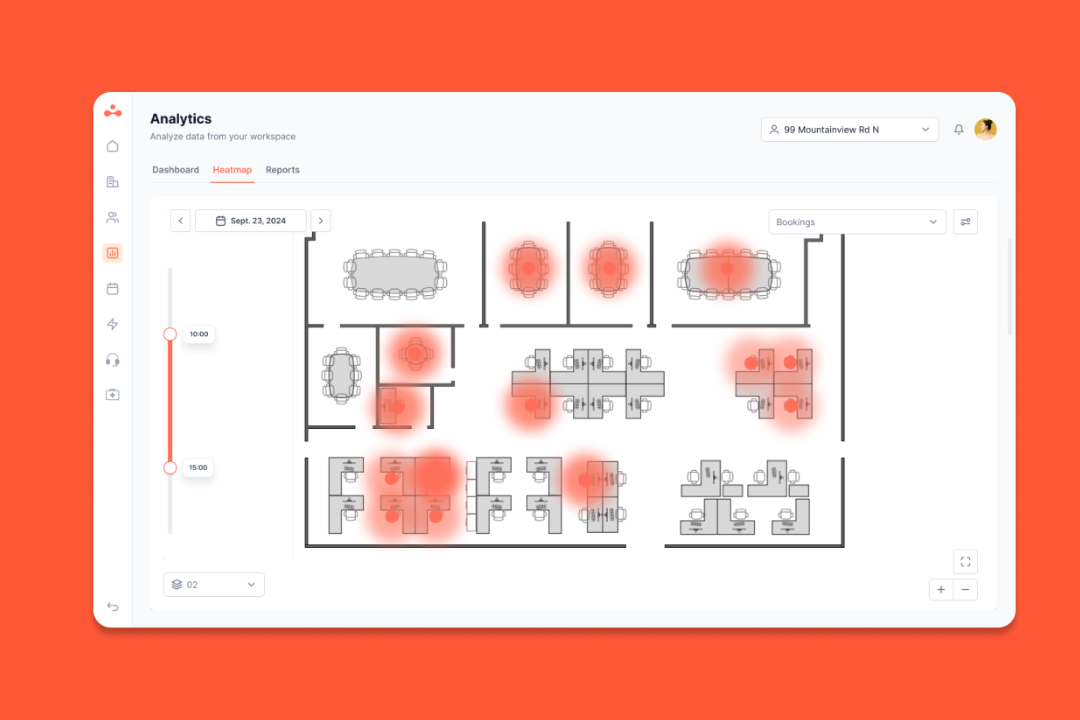
Occupancy management uses battery-powered desk sensors and room passage sensors to track how spaces are used. No wiring or IT setup. Heatmaps and dashboards show real occupancy.
Health and safety tracks first responder availability on the floor plan in real time, logs incidents digitally, sends certification renewal alerts, and keeps compliance records up to date.
Pricing
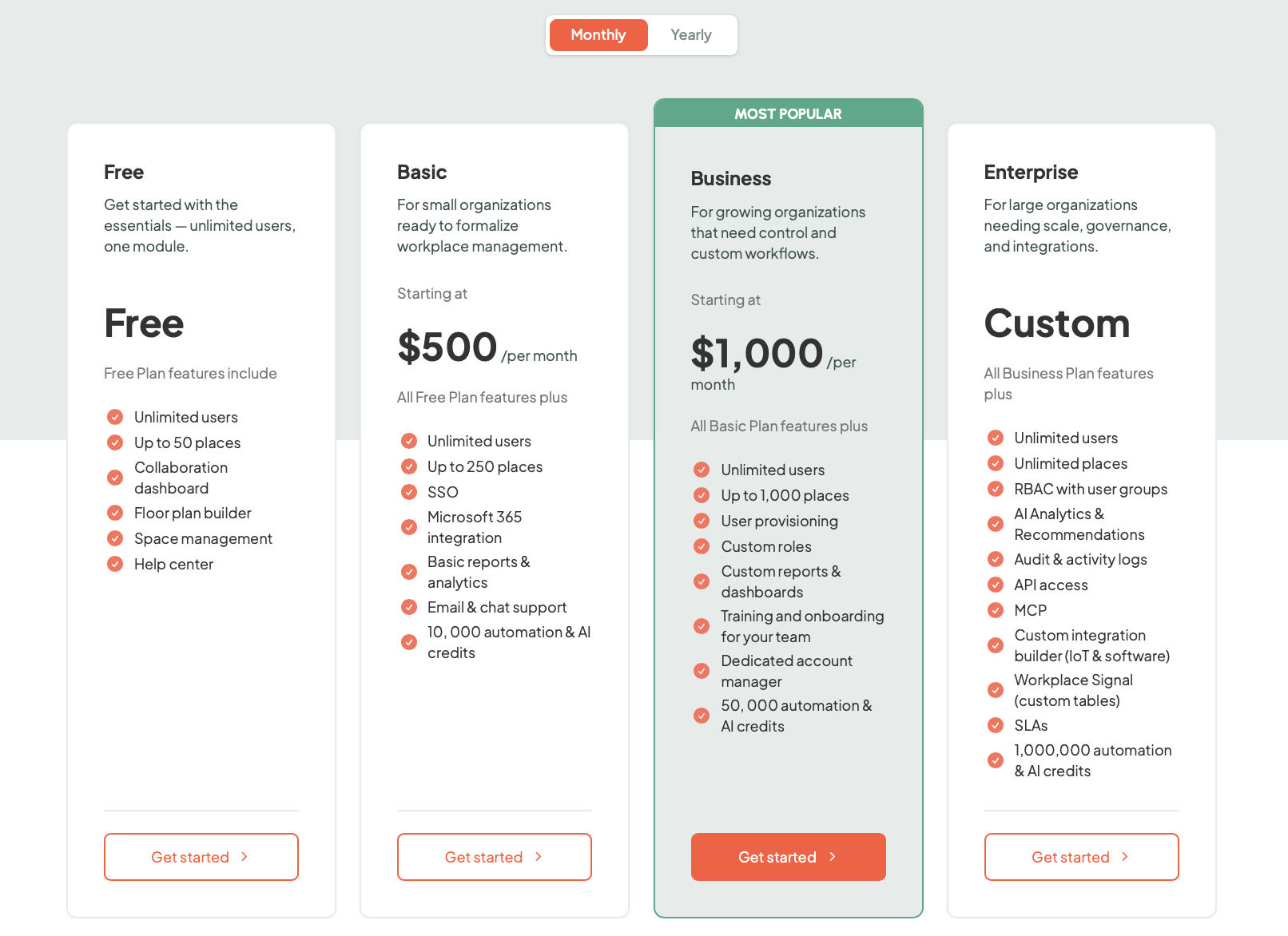
elia's pricing is tiered by the number of places (desks, rooms, lockers, and parking spots), with unlimited users on every plan and a free tier to start. Hardware is optional on top of any plan.
Plan
Price/month
Users
Places
Free
$0
Unlimited
Up to 50
Basic
From $500
Unlimited
Up to 250
Business
From $1,000
Unlimited
Up to 1,000
Enterprise
Custom
Unlimited
Unlimited
Optional hardware includes desk sensors, room sensors, room display screens, kiosks, and IoT gateways, all manufactured by elia and connecting natively to the platform.
Source: elia
Where they shine
Capterra named elia Best Ease of Use and Software Advice named it Best Customer Support for 2026 across every category they're listed in: Space Management, Desk Booking, Meeting Room Booking, and Visitor Management.
You don’t need any training. You can launch it to your entire company without doing a formal onboarding session.
Admins manage the floor plan from day one. Skedda routes initial setup through their team before handing off self-service editing. Robin's quick drafts cover small tweaks but major changes still go through their team. With elia, an admin owns the floor plan end-to-end from the moment they log in.
The health and safety module has no equivalent in Skedda or Robin. elia has first responder tracking on the floor plan, incident logging, and certification renewals.
It’s all from one vendor. Desk sensors, room sensors, room displays, and the kiosk all connect directly to the platform. No middleman between your sensor data and your dashboard.
What to consider
Paid tiers cap the number of places. It's worth running the numbers on your specific inventory (desks, rooms, lockers, and other bookable places) before you commit, though the free plan lets you start at up to 50 places. Users are unlimited on every tier.
Hardware is extra. To get live space data, you'll have to buy some sensors, and those are separate from the pricing plan. It adds up depending on how much of your space you want to track.
The integration ecosystem is narrower than Robin's. elia connects with Microsoft, Google, and Slack, but doesn't have Robin's access control integrations (Brivo, Gallagher, Genetec) or direct HRIS connections. If your workplace data needs to talk to your badge system or HR platform, Robin has a real advantage there.
The review base is small (57 Capterra reviews), and they're not on G2 yet. They're expanding outside Canada, so this is changing, but it's worth knowing if review depth is part of how you evaluate tools.
Where elia differs from Skedda vs Robin
Feature
Skedda
Robin
elia
Health and safety module
No
No
Yes
Floor plan self-service
Yes (after initial setup)
Partial
Yes (from day one)
Own hardware
No
No
Sensors, displays, kiosk
Pricing on website
Yes
No
Yes
Free plan
No
No
Yes, up to 50 places
Free trial
Yes (14 days)
No
No
A few other tools
These don't get the full treatment here, but depending on your situation they're worth looking at:
Envoy: if visitor management is the primary problem and desk booking is secondary. Envoy built its name on front desk and security workflows. That's still where it's strongest.
deskbird: a European desk booking platform with a genuine data privacy focus. Worth including in an evaluation if your team is EU-based and GDPR compliance is a hard requirement.
Kadence: built around hybrid work coordination and team scheduling rather than space management. A different angle on the same problem.
Microsoft Places: worth knowing if your organization is already deep in Microsoft 365. Functionality is more limited than the tools above, but the integration may be enough if you're not looking to add another vendor to the stack.
Do you need granular booking rules at a transparent price? Yes? Skedda.
Do you have 500+ employees and need analytics to drive real estate decisions? Yes? Robin.
Do you want one vendor for the whole workplace stack instead of managing separate tools for booking, sensors, and visitor management? Yes? Book a demo and see if elia fits.
Tamara Zhostka
is a Content Marketing Specialist at elia. With 10+ years in content marketing, she writes about workplace trends and the tools that help teams work smarter. Part strategist, part storyteller, Tamara brings equal amounts of data, creativity, and a little Moon Prism Power to every piece she creates. 🌙✨
Share
Contents
Subscribe to our newsletter
Subscribe to the elia newsletter for exclusive product updates and industry best practices. You can unsubscribe at any time.
Thank you! You're subscribed.
Oops! Something went wrong while submitting the form.
Skedda vs Robin FAQ
Answers to Your Common Queries
What's the main difference between Skedda and Robin?
Is Robin worth it for a team under 500 employees?
Which is better for visitor management, Skedda or Robin?
What does Robin actually cost?
Is Skedda good for hot desking?
Which tool is easier to set up?
When does elia make more sense than Skedda or Robin?


.png)
.png)